iv.
Economy & Markets
A real player economy with an order book, price history and anti-inflation taxes — gear flows toward whoever values it most, and every coin has a faucet and a sink.
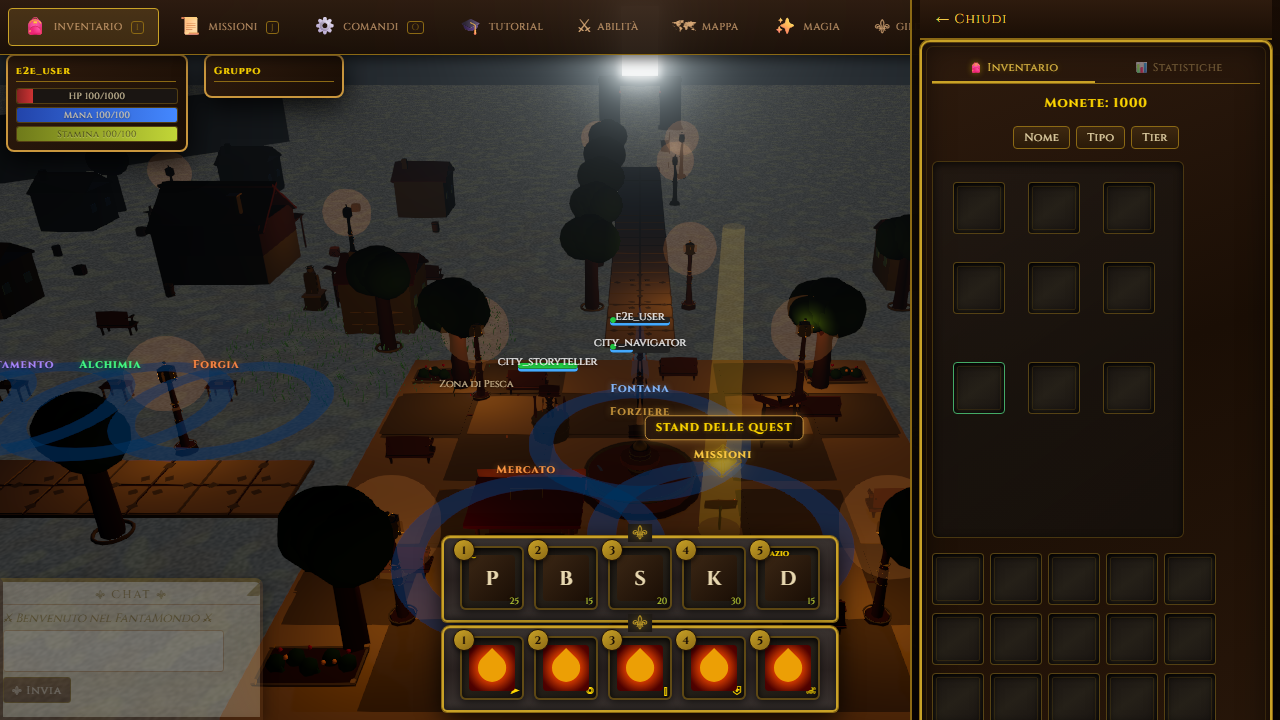
Every item remembers where it came from. Every coin remembers where it’s going.
Every item remembers where it came from; every coin remembers where it's going. The market is not a chart: it is an auction house with a real order book, where you browse listings, undercut your rivals, and leave buy orders that fill themselves when a seller appears — even while you're offline.
It is an economy that defends itself. Every action pays a small cut — broker, listing, cancellation — that destroys coins and protects your buying power; the price history lets you bargain as an informed merchant. The inventory carries each item's provenance, "Made by: <name>", and nothing is lost on relog. What you sell and what you buy flows toward whoever values it most.
Every coin has a faucet and a sink: it enters where the world mints it, it leaves where the world consumes it. That is how value stays value.
The features
-
Auction house (sales and buy orders)
A 4-tab market gated by proximity to a stall: you browse listings filtered by category and sorted by price, sell by drag-and-drop, place buy orders that fill themselves when a seller appears, and manage your own. Every row names the player selling it, and coins and items change hands automatically.
A real economy: undercut your rivals, snap up bargains, or leave orders that fill while you’re offline.
Playable now -
Market taxes and price history
Every market action takes a small cut (5% broker, 3% listing, 2% cancellation) that destroys coins, plus a per-item price history you can consult to judge a fair price.
Tax = a coin sink that protects your buying power, and the history lets you trade as an informed merchant.
Playable now -
Offline deliveries (settlement)
When a listing sells or an order fills while you’re away, coins or items are queued and delivered safely on your next login.
Nothing is lost if a trade closes while you’re offline — the market works for you 24/7.
Playable now -
Black market (gear sink)
A proximity-gated NPC counterpart that BUYS what the world consumes — gear, raw materials, potions — for minted coins, under a daily cap: the goods leave the world and come back re-equipped or drunk by the NPCs you might face.
There’s always a buyer for your surplus loot — and what you sell literally arms the enemies you meet.
Playable now -
Player-to-player trade
A direct trade window between two nearby players: each side offers items and coins, both must confirm, and the swap happens atomically.
A safe face-to-face swap — both sides lock the offer before anything changes hands.
Playable now -
Inventory and item provenance
A 40-slot inventory where items stack, move/split/merge/sort and carry the maker’s label (“Made by: <name>”) and their tier. Procedural icons render items with no asset downloads.
Rich, reliable inventory management where every item tells its origin, with no data loss on relog.
Playable now -
Storage chests
You place and use chests (on your island) to stash items beyond your carried inventory, opening an interface to move items in and out.
Extra storage for hoarders — deposit your loot instead of dropping it.
Playable now -
Corpse and container looting
Fallen creatures and containers hold a lootable inventory you open, browse and take from slot by slot — and a guild that loses an outpost sees the gear in its barracks spill onto the ground for whoever is still standing.
Loot is a place you go and a thing you can lose, not a number that appears in your bag.
Playable now -
Full-loot zones
In the ruins, the arena, the crystal cavern and the volcanic peak, dying spills your whole inventory and worn gear into a bag anyone can open. The city, the forest, private islands and wave instances never do — the table that decides this is deliberately kept apart from the PvP one, so every zone is decided twice. Everywhere, death also burns 5% of the coins you carry.
Real stakes where the reward is real, and a beginning that stays safe.
Playable now -
Carried weight, bags and pack animals
Every item weighs something. Bare-handed you haul 120 kg; a crafted bag adds 25 to 120 kg, and the mount under you another 40 to 220. Below 80% of capacity nothing slows you at all; at the limit you move at 0.85 speed, and never worse than half however far you overload.
Hauling becomes a decision — what you leave behind, which bag you bothered to craft, and whether it was worth bringing the mount.
Playable now
Current state
All eight features are playable now: the auction house with buy orders, taxes and price history, offline deliveries, direct player-to-player trade, inventory with provenance, storage chests, corpse and container looting, and the black market — the NPC counter that buys your gear to arm enemies. The market economy is fully live.